Farmington, MI · Garage Door Service
Is Your Farmington Garage Door Worth Repairing
Farmington's garage doors mostly date to the 1960s and 70s. Here's how to tell if yours is worth repairing or past the point, given our winters.
- Repairs & new doors
- Springs & openers
- Serving 6 nearby communities
What Local Conditions Do
Most of the housing stock around here went up between 1938 and 1986, with the bulk of it clustered in the 1960s and 70s. That matters because a door built or installed during that stretch has been through fifty-plus winters of a cold, severe climate band - the kind where steel contracts hard overnight, weatherstripping turns brittle, and lubricant that worked fine in July gums up by January. A door that's merely old in a mild climate can coast for decades. A door that's old here has been doing real work against freeze-thaw cycling every season it's stood.
That cycling is hardest on the parts that flex: torsion springs lose tension faster when they're constantly contracting in cold, rollers crack instead of just wearing smooth, and steel panels with any rust start flaking at the seams rather than just the surface. None of this is dramatic - it's slow fatigue, the kind you don't notice until the door starts binding on a 10-degree morning and runs fine again by afternoon. If your house falls into that median-1960 build window, the hardware behind the door has likely seen more cold-stress cycles than the door itself has years of paint left.
The Common Mistake
The mistake we see most is spending money on the opener when the actual problem is the spring or the track. Homeowners hear grinding or see the door stutter and figure the motor's dying, so they replace it - and the new opener fights the same worn spring and the same bent track, and the symptom comes right back within a season.
This gets worse with houses built in that 1960s-70s window because the original torsion hardware on a lot of these doors was sized for a lighter, single-layer door, not the heavier insulated replacements some owners installed later. A new opener bolted onto undersized, cold-fatigued springs is just a stronger motor straining against the same bad lift balance. It'll work for a while. It won't last, and it puts more load on the opener's gears than they're built for.
The honest fix order is spring and track first, opener only if the motor itself is actually failing - burning out, not just straining. We won't sell you an opener to mask a spring problem, because it comes back and you've paid twice.
What to Check
Start with the springs: if the door feels heavy when you lift it by hand with the opener disconnected, or it slams down instead of lowering evenly, that's spring fatigue, not an opener issue. Next, look at the bottom panel and weatherstripping - cold-climate seals harden and crack faster than people expect, and a cracked seal on a door from the 1960s-70s era is often original or near-original, not something replaced along the way.
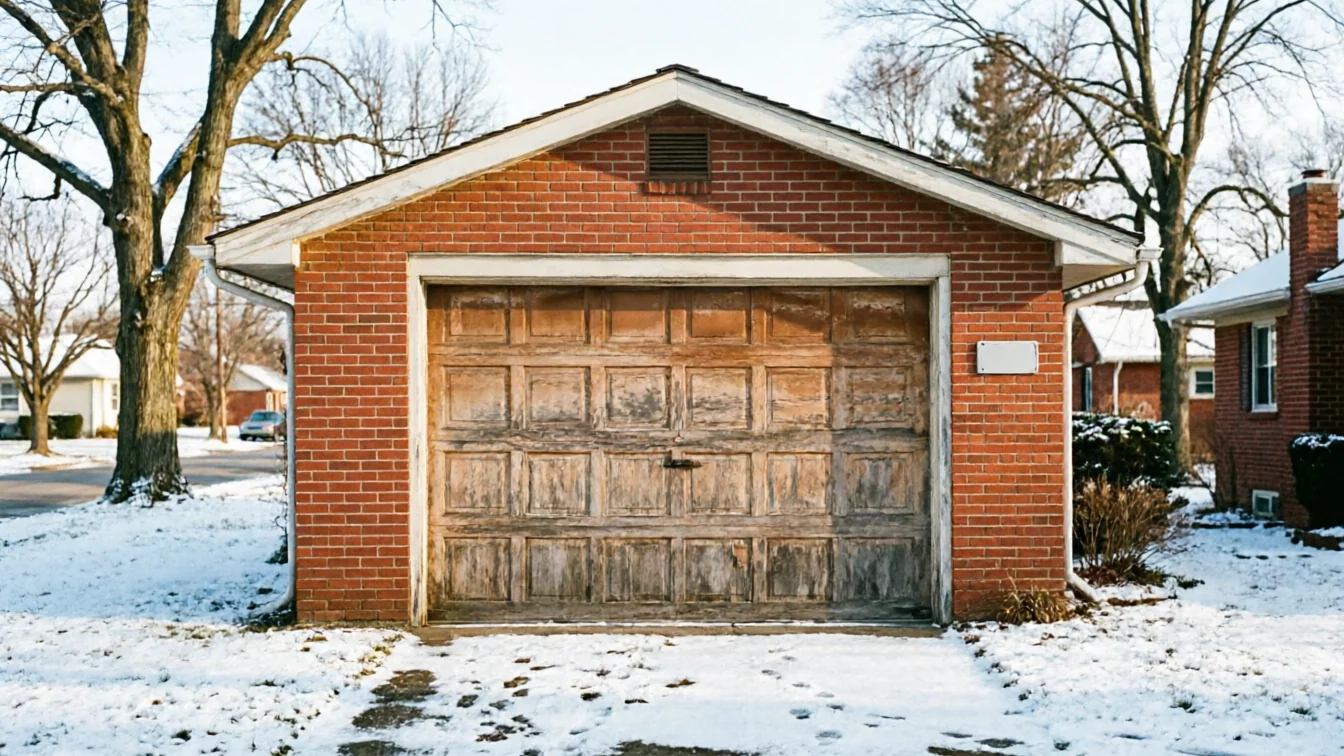
Check the track for rust bloom at the joints, especially near the floor, since that's where road salt and snowmelt sit longest against steel. And check the panels themselves for rust-through versus surface rust - surface rust on an otherwise sound steel door is cosmetic; rust-through at a seam means the panel is structurally compromised and painting over it won't help.
If your home is on the older end of that 1938-1986 range, also check whether the door is a single layer of steel with no insulation. That's common on original installs and it's a legitimate reason a door that technically still opens and closes is worth replacing rather than patching, given how exposed those thin panels are to a severe winter swing.
The Situation
With median household income in the area around $99,286 and a large share of owner-occupied houses - roughly 27,000 out of 49,000 households - most people here aren't choosing between fixing and replacing on price alone. The real question is whether the door's structure is sound enough that a repair holds through another cold season, or whether the fatigue is in the panel itself and not just the hardware.
A straight answer: if the springs, rollers, and track are worn but the panels are solid steel with no rust-through, repair is almost always the right call and it's not close. If the panels are rusted through at the seams, or the door is a single uninsulated layer original to a 1960s build, replacement makes more sense long-term, because you'd be repairing hardware around a shell that's already failing.
One limitation worth saying plainly: we can't always tell which one it is from a phone description. A door that sounds like 'just needs a tune-up' sometimes turns out to have rust we can't see until we're standing in front of it, and we'd rather tell you that in person than guess over the phone.
Frequently asked questions
How do I know if my garage door spring is actually broken or just worn out?
A fully broken torsion spring usually means the door won't lift at all, even with the opener, and you'll often see a visible gap in the coil. A worn spring still lifts the door but feels heavy, lowers unevenly, or lets the door drop the last foot. Given our winters, worn springs on older doors tend to show up as a sudden stiffness on cold mornings before they fail outright.
Is it worth replacing just the panel instead of the whole door?
Sometimes, if the door is a common size and the rest of the panels are sound. But doors original to houses built in the 1960s and 70s often used sizes or styles that aren't matched easily anymore, so a single panel swap isn't always possible. We'd need to look at it in person before saying either way.
Why does my door act up more in winter than summer?
Steel contracts in the cold, so any slack in the track or play in worn rollers gets more noticeable. Spring tension also shifts slightly with temperature. None of that is unusual in a severe cold climate like ours - it's just the hardware under more stress than it is in warmer months.
Related garage door services in Farmington
More garage door guides
Book garage door service in Farmington
Call now or request a quote - tell us what the door is doing and where you are.