
Farmington, MI · Garage Door Service
Openers and Power Outages: What Farmington's Older Housing Stock Means for You
Farmington homes built mostly between 1960 and the mid-1980s often run openers with no battery backup. Here's what cold-season power outages expose, and what to check first.
- Repairs & new doors
- Springs & openers
- Serving 6 nearby communities
What Local Conditions Do
Most houses in this part of Farmington went up between 1938 and 1986, with the bulk clustered around 1960. That matters for openers because a lot of those units were installed, or replaced, before battery backup was standard equipment. When the power goes out, which happens here with some regularity given the severe end of the cold climate band Farmington sits in, an opener without a backup battery just stops. No warning light, no slow fade, it's dead until the grid comes back.
Cold adds a second problem on top of that. Grease in an older chain-drive opener thickens in sustained cold, and a motor that's already working against stiff grease has less reserve capacity when the power blinks on and off during a storm, which is common with ice and wind events in this climate band. The combination of older housing stock and severe cold isn't unique to one street, it runs across the postwar-era homes that make up most of this area. If your opener is original to a 1960s or 70s build, it was not designed with today's power grid interruptions in mind.
The Common Mistake
The mistake we see most is a homeowner assuming a dead opener during a power outage means the motor burned out. Nine times out of ten in a house from this era, the problem is simpler: no battery backup, or a battery backup that was installed but never tested and quietly died years ago.
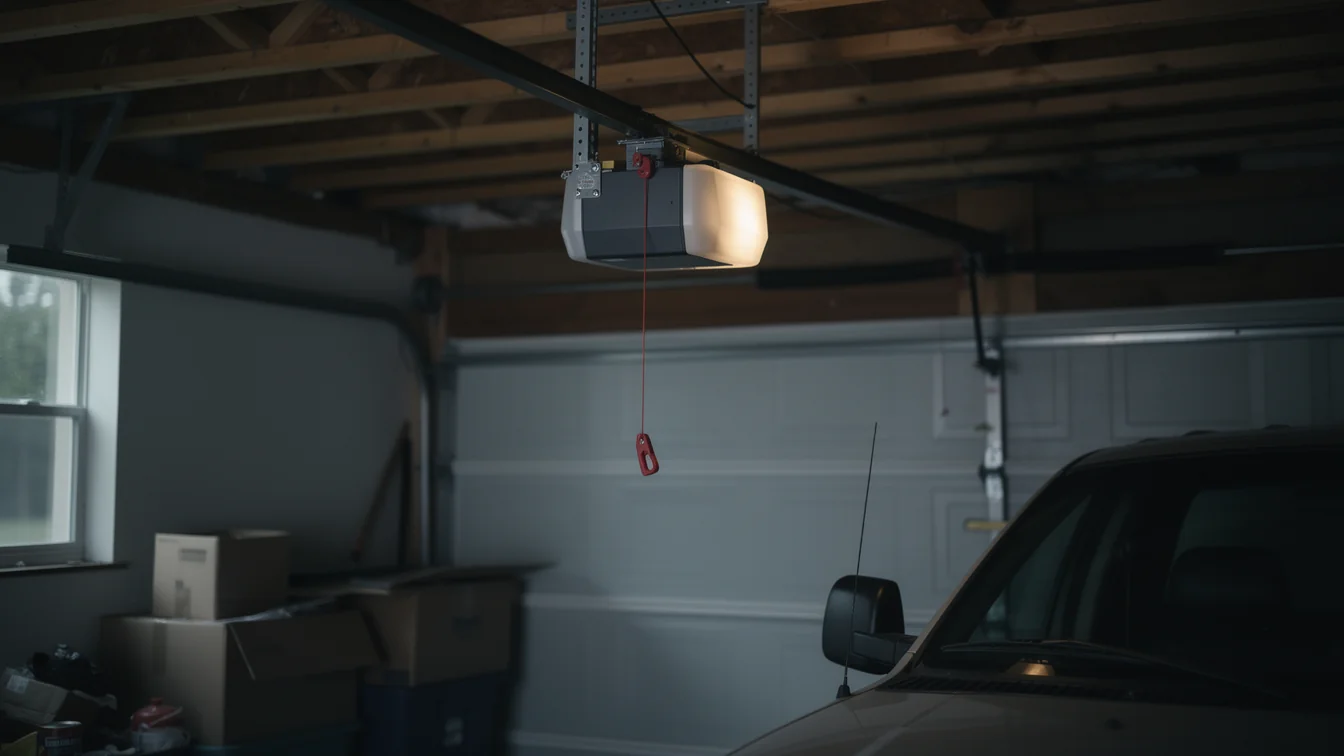
The second common mistake is not knowing where the manual release cord is, or not pulling it correctly, on an opener that predates the newer release mechanisms. In a lot of Farmington's older houses, the opener has been swapped once or twice since the original 1960s install, but the release hardware sometimes gets reinstalled in a spot that doesn't match newer manuals. During an actual power outage, in the dark, in the cold, that's not the time to be hunting for it. We'd rather you know the release location before you need it than after.
What to Check
Start with the battery backup unit if your opener has one. Most newer openers include a battery pack, but it needs to hold a charge, and in a cold garage that charge drains faster than it would in a heated space. Test it by unplugging the opener and seeing if the door still runs.
Next, check the manual release cord and make sure you can reach and pull it without a step stool in an emergency. In older homes built in the 1960s and 70s, this cord sometimes sits closer to the track than modern installs, so look for it rather than assuming it's dead center.
Last, look at the wiring itself. An opener original to a house from this era, or wired during a past upgrade without much thought to surge protection, is more exposed to damage from the kind of voltage spikes that come with power restoration after an outage. A simple surge protector on that circuit is a low-cost fix. If the wiring looks brittle or taped-over, that's worth a second look before winter, not during it.
The Situation
Across the area, there are 26,971 owner-occupied houses out of roughly 49,017 households, and median household income runs around $99,286. That's enough that most owners here can reasonably afford a battery backup retrofit or an opener upgrade when the old one is past its useful life, but plenty of garages still run on original 1960s and 70s wiring simply because nobody's had a reason to touch it yet.
Farmington sits within a tight radius of several similar communities, Franklin, Northville, and Bingham Farms around six miles out, Walled Lake and Plymouth a bit further, all built up in roughly the same postwar decades. The housing stock question isn't unique to one town, it's a regional one tied to when this whole area got built.
One limitation worth saying plainly: we don't install whole-house standby generators. If your real goal is keeping everything running through an outage, not just the garage door, that's a different job and a different contractor. We can get your opener itself reliable through a power outage. We won't pretend to solve the whole-house problem.
Frequently asked questions
Why does my garage door opener stop working completely when the power goes out?
If your opener doesn't have a battery backup, it has no power source once the grid drops, so it simply stops. This is common in openers original to Farmington's 1960s and 70s housing stock, installed before battery backups were standard. A backup battery, tested regularly, is the fix.
Where is the manual release cord on an older opener?
It varies by model and by how the opener has been serviced over the years. In a lot of Farmington homes from this era, the opener has been replaced at least once since the original 1960s install, so the release cord position doesn't always match the current manual. Locate and test it before you need it in a blackout.
Does cold weather make power-cut problems worse?
Yes. Farmington sits in a severe cold climate band, and grease in an older chain-drive opener thickens in sustained cold. A motor already working harder against stiff grease has less reserve when power cycles on and off during a winter storm, which raises the odds of a stall or a tripped breaker.
Should I just replace my old opener instead of adding a battery backup?
Depends on the opener's age and condition. If it's original to a 1960s or 70s build and already showing wear, a full replacement with built-in battery backup often makes more sense than retrofitting. If it's newer and running fine otherwise, adding a backup battery is the cheaper fix.
Related garage door services in Farmington
More garage door guides
Book garage door service in Farmington
Call now or request a quote - tell us what the door is doing and where you are.